
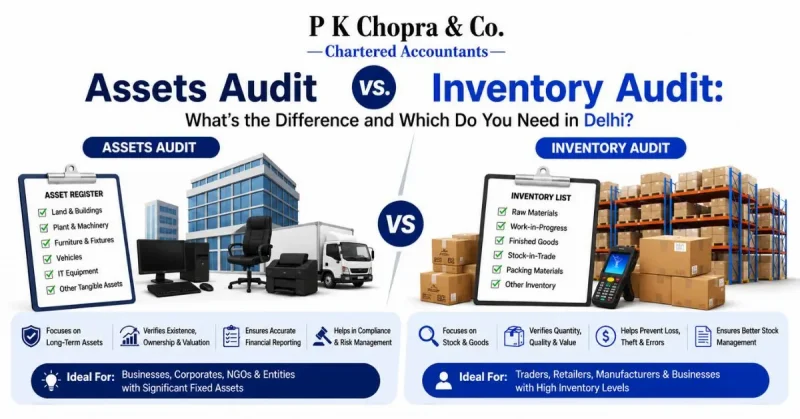
Assets Audit vs. Inventory Audit: What’s the Difference and Which Do You Need in Delhi?
Businesses in Delhi manage a wide range of resources—from office equipment and machinery to raw materials and finished goods. Keeping accurate records of these resources is essential for financial reporting, regulatory compliance, insurance and operational control.
Two audits commonly used for this purpose are an assets audit and an inventory audit. Although they may sound similar, they examine different areas of a business. Understanding the difference can help you choose the right audit for your organisation.
What Is an Assets Audit?
An assets audit is a systematic review and physical verification of a company’s fixed assets. These are long-term resources used to operate the business rather than items purchased for resale.
Fixed assets may include:
- Land and buildings
- Plant and machinery
- Computers and laptops
- Furniture and fixtures
- Vehicles
- Office equipment
- Electrical installations
- Leasehold improvements
During an assets audit, auditors compare physical assets with the company’s fixed asset register and accounting records. They confirm whether each asset exists, where it is located, who is responsible for it and whether it is properly recorded.
The audit may also examine asset identification numbers, purchase details, depreciation, ownership documents, asset condition and disposal records.
What Is an Inventory Audit?
An inventory audit focuses on goods that a business holds for manufacturing, sale or consumption during its normal operations.
Inventory may include:
- Raw materials
- Work in progress
- Finished goods
- Trading stock
- Packaging materials
- Consumable supplies
- Spare parts
The objective is to confirm the quantity, condition, ownership and valuation of stock. Auditors may conduct physical stock counts, inspect damaged or obsolete items and compare actual quantities with inventory records.
Inventory audits are particularly important for manufacturers, wholesalers, retailers, restaurants, pharmacies and e-commerce businesses operating in Delhi.
Assets Audit vs. Inventory Audit: Key Differences
| Basis | Assets Audit | Inventory Audit |
| Main focus | Long-term fixed assets | Goods held for sale or production |
| Examples | Machinery, computers, vehicles and furniture | Raw materials, finished products and consumables |
| Business purpose | Supports operations over several years | Sold or consumed during normal operations |
| Records reviewed | Fixed asset register and general ledger | Stock register and inventory management system |
| Key verification | Existence, ownership, location and condition | Quantity, quality, condition and valuation |
| Accounting concern | Capitalisation and depreciation | Cost of goods sold and closing stock |
| Common risks | Missing, unrecorded or disposed assets | Shortages, excess stock, damage and obsolescence |
| Frequency | Usually annual or periodically | Annual, quarterly, monthly or continuously |
Why Is an Assets Audit Important?
An assets audit helps a business maintain reliable information about the resources it owns and uses. It can uncover assets that are missing, damaged, duplicated or no longer operational.
Major benefits include:
1. Accurate Fixed Asset Records
Physical verification ensures that the fixed asset register matches the assets available at different offices, branches, warehouses and project locations.
2. Better Control Over Business Property
Asset tagging and location tracking reduce the chances of loss, unauthorised transfer and misuse.
3. Correct Depreciation
Incorrect purchase dates, classifications or useful lives can lead to inaccurate depreciation. An audit helps identify and correct such issues.
4. Identification of Idle Assets
Unused equipment continues to occupy space and may generate maintenance or insurance costs. An audit helps management decide whether such assets should be repaired, transferred, sold or disposed of.
5. Stronger Financial Reporting
Accurate asset records improve the reliability of the balance sheet and support statutory, internal and tax-related reviews.
Why Is an Inventory Audit Important?
Inventory often represents a substantial portion of a company’s current assets. Even small errors in stock records can affect profit calculations, cash flow and purchasing decisions.
An inventory audit can help with:
1. Detecting Stock Differences
It identifies shortages or excess quantities by comparing physical stock with recorded balances.
2. Preventing Fraud and Pilferage
Regular verification discourages unauthorised removal, manipulation and misuse of inventory.
3. Identifying Damaged or Obsolete Stock
Slow-moving, expired or unusable goods can be separated and valued appropriately.
4. Improving Inventory Planning
Reliable stock data helps avoid unnecessary purchases, production delays and stockouts.
5. Supporting Accurate Valuation
An inventory audit reviews whether stock valuation methods are consistently applied and supported by appropriate records.
Which Audit Does Your Delhi Business Need?
The right audit depends on the nature of your operations and the risks you want to address.
Choose an Assets Audit If:
- Your company owns significant machinery, vehicles or equipment.
- You have offices or branches across Delhi-NCR.
- Assets frequently move between employees or locations.
- Your fixed asset register has not been updated recently.
- You are preparing for a statutory audit, merger, acquisition or insurance review.
- You suspect missing, duplicated or unusable assets.
Choose an Inventory Audit If:
- Your business manufactures, stores or sells physical products.
- Actual stock frequently differs from the system balance.
- You handle perishable, high-value or fast-moving goods.
- You need to identify slow-moving or obsolete inventory.
- Your business has multiple warehouses or retail locations.
- Inventory has a significant impact on your financial results.
Choose Both Audits If:
Many businesses require both audits. For example, a Delhi-based manufacturing company may own production machinery as fixed assets while also holding raw materials and finished goods as inventory.
Conducting both audits provides a more complete view of the company’s resources, controls and financial records.
How Are These Audits Conducted?
A structured audit generally includes the following stages:
- Planning: The auditor understands the business, locations, records and scope of verification.
- Record review: Fixed asset registers, stock ledgers, invoices and supporting documents are examined.
- Physical verification: Assets or inventory items are counted, inspected and matched with available records.
- Reconciliation: Physical results are compared with accounting or management systems.
- Exception analysis: Missing, excess, damaged, obsolete or unrecorded items are identified.
- Reporting: Management receives findings, reconciliation statements and recommendations for improvement.
- Corrective action: Records and internal controls are updated based on approved findings.
Common Issues Identified During Audits
Assets and inventory audits may reveal:
- Missing or untraceable items
- Duplicate records
- Incorrect asset locations
- Untagged fixed assets
- Disposed assets still appearing in records
- Unrecorded purchases
- Damaged or expired stock
- Negative inventory balances
- Incorrect depreciation
- Weak approval and transfer processes
- Differences between physical and recorded quantities
Addressing these issues can reduce financial loss and improve decision-making.
Why Delhi Businesses Need Regular Verification
Businesses in Delhi often operate from multiple offices, warehouses, factories and retail locations. Frequent asset movement, high transaction volumes and complex supply chains can make accurate recordkeeping difficult.
Regular verification helps organisations maintain control, prepare reliable financial statements and respond confidently to auditors, lenders, insurers and management reviews.
Conclusion
An assets audit verifies long-term resources such as machinery, computers, furniture and vehicles. An inventory audit, on the other hand, examines goods held for production, sale or consumption.
If your concern is missing equipment, inaccurate depreciation or outdated fixed asset records, you need an assets audit. If your concern is stock shortages, obsolete goods or incorrect inventory valuation, an inventory audit is more appropriate. Businesses managing both fixed assets and stock should consider conducting both audits for stronger financial and operational control.
Professional audit support can help Delhi-based businesses establish accurate records, identify discrepancies and implement more reliable internal controls.